|
|
|
 |
39°40'N
31°07'W CORVO AIRPORT -
Europe’s smallest airport in America by Stephan Weidenhiller 09 October 2006 |
|
Only a few civilian airports can say that
they are American and European. The airport of the Azorean island Corvo is
Europe’s 2nd most westerly airport and at the same time
America’s most easterly airport.
|
|
||
|
|
|
|
|
|
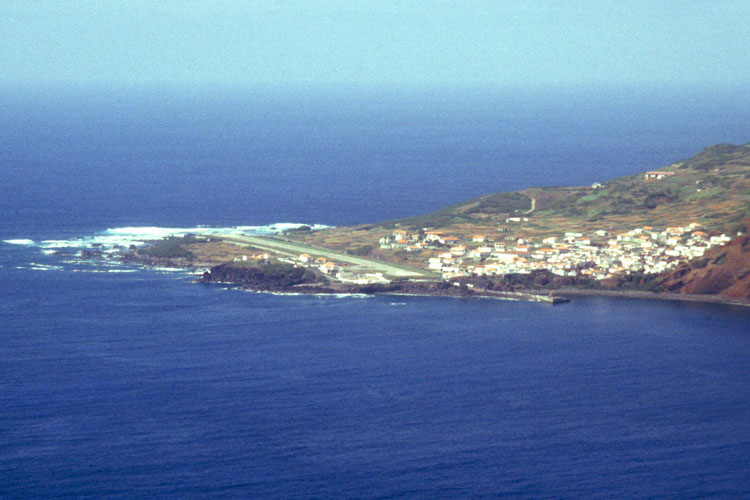
Since 1993 Corvo has one of the world’s smallest commercial airports. An estimated 8000 – 8500 passengers use the facility yearly. But the airport is only operational on three days per week. When we travelled there in September the airport became on Mondays, Wednesdays and Fridays the gateway to the world for the island and its 425 inhabitants. Geographically seen, Corvo becomes the starting point of the only known scheduled intercontinental flight operated by a Dornier Do228. On these days, the small 13x13meter “big” terminal fills itself slowly and passengers, meeters and greeters await the landing of the SATA Air Acores Dornier Do228 from Horta (Faial Island). Short before lunchtime, the 18seater touches down on the 600meters long runway, which is aligned 12 –30.
After entering the terminal through one of
the building’s four doors, passengers await baggage reclaim at the next
door. Especially the big amount of outsize baggage is noticeable: Wipers,
TVs and kitchen gear are only a few things for households brought to Corvo
by plane. Of course, also mail is delivered with the aircraft.
|
|||
|
|
The Terminal at Corvo is simply made but not dated. Despite you look for flight information displays or baggage belts in vain, but there is for example a 100% computer check-in. The gate for arriving and departing passengers is the same. Also security checks are not conducted at Corvo. The 425 inhabitants of the island are all well known and the rest of the passengers were already checked on their flights to Corvo. The cellar of the terminal is home to the voluntary fire fighters. But the airport has its own fire brigade, to ensure a maximum of safety. The fire brigade has its own truck that is based in a small garage next to the terminal. The airport is situated nearly in the centre of the island capital Vila Nova. By foot you get in about 5minutes to the church, the centre of the smallest capital on the Azores. In the early afternoon the same row happens in the opposite direction. From Flores arrives the well-booked Do228 in Corvo. The flight mostly transports connecting passengers from Ponta Delgada, the biggest town on the Azores and gateway to the world. Connecting passengers are handled perfectly at Corvo. Who comes from Flores and flies onward to Horta, has to leave the aircraft and can reboard the aircraft 15minutes later.
At 14:20 the Dornier Do228 CS-TGO of SATA
Air Acores departs for its intercontinental flight to Horta airport, which
is situated 244km to the west on the island Faial. After the departure,
silence comes back on the small and beautiful airport for at least
40hours. |
||